 How-to
How to Sell a House Without a Real Estate Agent in 2026
Table of Contents
- What Selling a House Without a Real Estate Agent Really Involves
- The Real Cost to Sell a House Without a Realtor
- How to Price a House for Sale by Owner
- Prepping, Marketing, and Creating Your Property Listing
- Flat Fee MLS Listing: What You Get and What You Give Up
- Your FSBO Paperwork Checklist and Transaction Timeline
- Buyer-Agent Compensation, Negotiation, and When to Get Help
- Frequently Asked Questions
Last Updated: October 18, 2026

What Selling a House Without a Real Estate Agent Really Involves
Learning how to sell a house without a real estate agent means you take on every job a listing agent normally handles: pricing, marketing, showings, negotiation, and paperwork.
FSBO (For Sale By Owner) is a home sale where the owner lists and sells the property without hiring a listing agent.
The trade-off is simple. You save on the listing side, but you spend time, and mistakes cost money. Below, we'll show you exactly where those mistakes happen.
FSBO Versus Selling to a Cash Investor
A cash buyer is the fastest path and usually the lowest price. A real estate investor pays cash, skips financing contingencies, and often closes in weeks. You trade equity for speed and certainty.
An FSBO sale takes longer but usually nets more. You market to retail buyers who pay market value. The catch: you handle showings, inspections, and financing hiccups yourself.
The Real Cost to Sell a House Without a Realtor
The cost to sell a house without a realtor is not zero. You avoid the listing commission, but several expenses remain. Sellers commonly pay for:
- Buyer-agent commission, which is negotiable
- Title company fees and title insurance
- Transfer taxes and recording fees
Since the 2024 commission-rule changes, buyer-agent pay is no longer automatically offered through the MLS. You negotiate it directly, and you can offer nothing. Just expect fewer buyer agents to show your home if you do.
How to Price a House for Sale by Owner
Pricing is the step that decides everything else. Price too high and the home sits, then sells below market after price cuts. The Consumer Financial Protection Bureau's home sale guidance explains how appraisals and pricing interact, which matters when a buyer's lender orders one.
Use comparable sales, not asking prices. Asking prices reflect seller hope; closed sales reflect what buyers actually paid.
How to Select True Comparables
Not every nearby sale is a comparable. A workable comparable set usually meets these tests:
- Closed within the last six months (three months in a fast-moving market)
- Within roughly one mile in a suburban area, or a few blocks in a dense urban one
- Within about 20% of your home's square footage
Aim for three to five strong comps. If you cannot find five, widen the radius or the date window one step at a time and note why in your pricing file. Keep a written record of every comp you used and every one you rejected; buyers and appraisers will ask.
How to Adjust Comps for Condition and Upgrades
Raw sale prices are not the answer. You adjust each comp up or down for how it differs from your home. A common pattern among practitioners is to apply modest dollar adjustments rather than percentage guesses:
- Square footage: adjust by a per-square-foot value drawn from local sale data, not a national average
- Bathrooms: a full bath typically adds more than a half bath; use local paired sales to set the number
- Garage: attached versus detached and space count matter; adjust in line with local buyer preferences
After adjusting, weight the closest matches most heavily. The adjusted values should cluster into a range. Set your asking price at the top of a defensible range, not above it, and pick a walk-away price before you list.
How Appraisals Feed Back Into Your Price
If your buyer finances the purchase, the lender will order an appraisal. An appraiser will pull their own comps and may not weight yours the same way. If the appraisal comes in below the contract price, the buyer's financing contingency can give them an exit or a renegotiation lever. Pricing within a defensible comp range reduces that risk. Keep your comp file, adjustment notes, and any improvement receipts ready to hand to the appraiser.
A Simple Pricing Worksheet
- Find three to five recent closed sales nearby that pass the comparable tests above
- Adjust each for size, bathrooms, upgrades, lot, and condition using local dollar figures
- Weight the closest matches most heavily and discard outliers
- Set your asking price within the adjusted range
- Pick a walk-away price before you list
- Recheck the comps every two to three weeks and cut the price if showings are slow
Pricing is not a one-time decision. A home that gets no showings in the first two to three weeks is usually priced above the market, and the fix is a documented price change, not more marketing.
Prepping, Marketing, and Creating Your Property Listing
Marketing a for-sale-by-owner home starts with condition, then reach. Buyers judge a property in seconds online, so photos and presentation carry the listing.
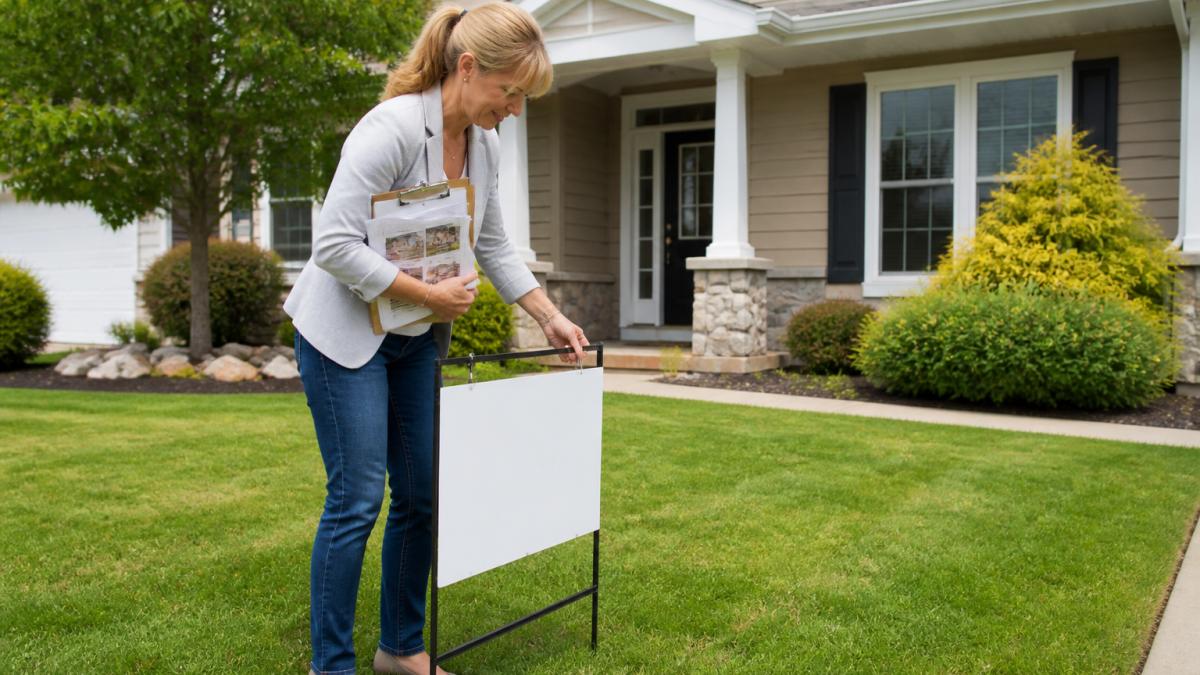
Prep work that pays off:
- Declutter and deep clean every room
- Fix small defects buyers notice, like leaky faucets and scuffed walls
- Repaint in neutral tones
Then build your property listing and spread it:

- Post on FSBO websites and your local online listing groups
- Put up clear signage with a phone number
- Print flyers with photos, price, and key specs
Flat Fee MLS Listing: What You Get and What You Give Up
A flat fee MLS listing puts your home in the local multiple listing service for a set upfront fee instead of a percentage commission.
What you give up is service. Most flat-fee packages include the listing entry and little else. You still handle showings, inquiries, negotiation, and paperwork.
The National Association of Realtors' guide to MLS and listing rules covers how listing data flows to public sites.
Your FSBO Paperwork Checklist and Transaction Timeline
Your FSBO paperwork checklist should cover every document from listing to closing, and it should say who prepares each one. Missing a document or a deadline can delay or kill a deal. The U.S. Department of Housing and Urban Development's homebuying resources outlines many of the disclosures and forms involved, and your state's real estate commission or attorney general publishes the disclosure forms required where the property sits.
Who Prepares Each Document
A common pattern in FSBO transactions is that the seller prepares disclosures and the pricing file, the buyer's agent or attorney drafts the purchase agreement, the title company or closing attorney handles title and settlement, and the lender produces the financing documents. Confirm each role in writing before you list so nothing falls through.
Document | Usually Prepared By | When |
|---|---|---|
Seller disclosure statement | Seller | Before listing |
Lead-based paint disclosure (pre-1978 homes) | Seller | Before listing |
HOA covenants, dues, and contact info | Seller, from HOA packet | Before listing |
Comparable sales and pricing notes | Seller | Before listing |
Purchase agreement and sales contract | Buyer's agent or attorney, or state form | At offer |
Counteroffer and addenda | Both parties | During negotiation |
Earnest money receipt | Escrow or title company | At acceptance |
Inspection reports and repair requests | Buyer's inspector; buyer's agent drafts request | During inspection period |
Appraisal report | Buyer's lender's appraiser | During financing period |
Title commitment and title insurance | Title company or closing attorney | After contract |
Loan estimate and closing disclosure | Buyer's lender | After application; before closing |
Closing statement (settlement statement) | Title company or closing attorney | Before closing |
Deed and transfer tax forms | Closing attorney or title company | At closing |
State Disclosure Rules Change the Checklist
Disclosure requirements vary by state, and some states require forms that others do not. Common examples include seller property condition disclosures, lead-based paint disclosures for pre-1978 homes under federal rules, and state-specific forms for HOA properties, coastal or flood-zone properties, and properties with known defects. Some states require an attorney at closing; others do not. Before you list, pull the required disclosure forms from your state's real estate commission or attorney general website and confirm with a local real estate attorney whether an attorney is required at closing.
A Complete Transaction Timeline
Timelines vary by market and financing type. Cash sales move faster than financed sales, and inspection and appraisal periods drive most of the schedule.
Stage | Typical Timing | Your Job |
|---|---|---|
List and market | Weeks 1-4 | Photos, signage, showings, disclosure packet ready |
Offer and counteroffer | Week 2-6 | Negotiate price and terms in writing; verify buyer financing |
Inspection | Days 1-10 after acceptance | Respond to repair requests in writing within the contract deadline |
Appraisal | Days 5-21 after acceptance | Provide comp file and improvement receipts to the appraiser |
Financing and title | Weeks 4-10 | Track contingencies; respond to lender and title requests |
Final walk-through | 24-48 hours before closing | Confirm condition and repairs |
Closing | Week 6-12 | Sign deed and settlement documents; transfer keys |
Deadlines That Kill Deals
The dates that most often cause trouble are the inspection response deadline, the financing and appraisal contingency deadlines, and the closing date. Every contingency has a date, and missing it can waive your right to respond or the buyer's right to exit. Put every deadline from the contract on one calendar the day you accept the offer, and confirm each one in writing with the buyer's agent or attorney.
Buyer-Agent Compensation, Negotiation, and When to Get Help
Buyer-agent compensation is now a negotiation, not a given. You decide whether to offer it and how much. Factor it into your net proceeds before you list.
Negotiation basics:
- Respond to every offer in writing
- Counter on price and terms, not just price
- Hold your walk-away price
When should you get help? Hire a real estate attorney for contract review if your state requires one, or if the deal gets complicated. Consider a limited-service arrangement if you want professional eyes on paperwork without a full commission.
Gina Poslusny with Weichert Realtors helps homeowners in the Phillipsburg area sell their homes, and helps buyers find their first or last home. We also work with investors buying and selling flips.
Frequently Asked Questions
Can you sell a house without a real estate agent?
Yes. Every state allows a homeowner to sell property without an agent, and buyers do not need one either. You take on the work an agent normally does: pricing, listing, showings, negotiation, and paperwork. The trade-off is time and risk, not legality. Expect to handle disclosures, the purchase agreement, and closing coordination with a title company or real estate attorney. Many FSBO sellers hire an attorney for a flat review fee, which keeps costs predictable while covering the parts where mistakes are most expensive.
How much does it cost to sell a house without a real estate agent?
You avoid the listing-side commission, but the cost to sell a house without a realtor is not zero. Budget for title and escrow fees, transfer taxes, prorated property taxes, any repairs, and marketing costs like signage, flyers, and photography. If you use a flat fee MLS listing, add that upfront fee. If you offer buyer-agent compensation, that amount comes out of your proceeds too. Build a net proceeds estimate before you list so you can compare it against an agent-assisted sale on the same price.
What paperwork do you need to sell a house by owner?
An FSBO paperwork checklist usually includes a seller's disclosure statement, a purchase agreement or sales contract, a lead-based paint disclosure for homes built before 1978, a title report, and any HOA covenants and contact information. Your state may require additional forms, such as property condition disclosures or a statement of utility costs. Keep copies of every signed document and every buyer inquiry. A real estate attorney can review the purchase agreement before you sign, which is cheaper than fixing a bad contract after closing.
How do you price a home when selling without an agent?
Start with comparable sales: recent closed sales of homes in your area with similar square footage, bedroom count, lot size, and condition. Adjust for differences like a finished basement, a new roof, or a busy street. Look at active listings to see what you are competing against and pending sales to see what buyers are actually paying. Do not price on what you need to net. Price on what the market supports, then set a walk-away number before you start negotiating.
What are the risks of selling a house without a real estate agent?
The main risks are mispricing, weak marketing reach, paperwork errors, and safety during showings. A home priced too high sits, then sells below market after price cuts. FSBO listings also get less exposure than MLS listings unless you pay for a flat fee MLS placement. On the paperwork side, missed disclosures can surface as legal problems after closing. For showings, screen buyers by phone, verify financing, and never show a home alone. An attorney review and a pre-listing inspection reduce most of these risks.
Selling on your own can work, but one pricing mistake or missed disclosure can cost more than the commission you saved. If you want a second opinion on your price, your paperwork, or your buyer, we're glad to help. Get started with Gina Poslusny with Weichert Realtors and sell with confidence.